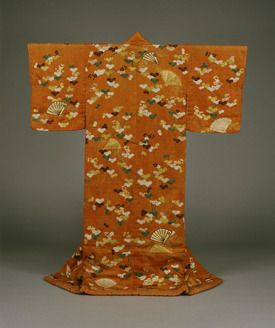
Hanger is a garment worn from autumn to spring, with thick cotton padding between its front and back. Worn over undergarments and secured with a sash at the waist. The pattern called "sakaki fan," favored in royal courts, is suitable for festive occasions such as weddings or New Year's Day on sunny days. Ruby: Aigi, kakeshita obi, hiougi, miyabi.
打掛は、秋から冬、春にかけて着用する、表地と裏地の間に厚く綿の入った女性の上着である。間着とよばれる着物を着て、掛下帯を締めた上からはおる。桧扇という王朝好みの雅やかな模様は、婚礼の場やお正月のような、晴れの日にふさわしい模様である。 ルビ:あいぎ かけしたおびし ひおうぎ みやび
View the original at Japan Search →A weapons statute that contains the most important art registry in the country. Article 2 defines a sword by measurement: a blade of fifteen centimetres or more for a sword, spear or naginata, five and a half for a dagger. Article 14 then carves out an exception. The prefectural board of education registers old firearms of value as art or antiques, and swords of value as art, on the basis of an appraisal by registration examiners appointed for their scholarly knowledge.
The cool part. A Japanese sword is lawful to own because it has been certified as art. Not because it was disarmed, not because it was licensed as a weapon. The judgement is made by the board of education, and Article 14 then requires the board to notify the prefectural public safety commission of what it has decided. The culture side rules, and the police are informed afterwards. Fail the appraisal and the same object becomes contraband.
Verify at e-Gov 法令検索 →Use it The border is the idea. Use it as an edge treatment and leave the centre empty.
Description source: museum curator text, translated — not generated