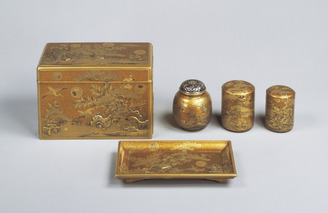
This museum piece demonstrates the intricate techniques of inlay and carving, typical of traditional Japanese painting during the Edo period. The reverse side bears a gold inlay seal with the name "Sonobe" (Gunbei). It is believed to have been created by the painter Sonobe (possibly the famous Sonobe Gunbei, active around 1660), or a descendant of his.
精細な付描や切金を用いた精巧な作行が、江戸時代における伝統様式の蒔絵の典型を示しています。蓋裏に「孫兵衛」の金蒔銘があり、本阿弥光悦の孫・妙久の夫で蒔絵師と推測される五十嵐孫兵衛(~1660)や、あるいはその後裔の作と考えられます。
View the original at Japan Search →A statute built to coax privately held work onto public walls. An owner registers a piece with the Commissioner for Cultural Affairs, then contracts with a museum to display it. Article 2 defines a work of art broadly, as paintings, sculpture, crafts and other tangible cultural products that are movable, which is the legal way of saying anything you could carry out of the house.
The cool part. The terms are the interesting part. Article 2 requires the public display contract to run for five years or more, and to contain a clause stating that the parties may not give notice of cancellation. You cannot lend a masterpiece for the tax treatment and then reclaim it when the market turns. Japan concluded the barrier to seeing art was never storage. It was ownership, and the fix was a contract you cannot walk out of.
Verify at e-Gov 法令検索 →Use it Two-colour foil on uncoated stock gets you most of this at production cost.
Description source: museum curator text, translated — not generated