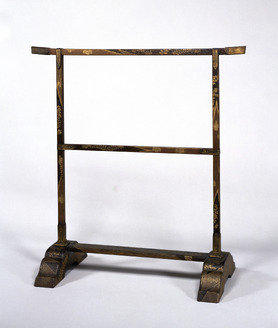
This item is used to place a cleaning cloth on one's hands when using water for cosmetic purposes such as washing or applying make-up. The surface is divided into squares with a metallic sheen and features thin, intricate paintings of bamboo, autumn grasses, and chrysanthemums. The autumn grasses are skillfully arranged with various types such as kikyou, nadeshiko, ominaeshi, and susuki. An example of high-style temple painting.
手拭掛は、洗面や鉄漿付(かねつ)け(お歯黒)など、水を使う化粧の際に、手を拭う布を掛けるための道具である。表面を雷光形に区画し、薄肉高(うすにくたか)蒔絵で桐紋や秋草を描いている。細長い面に菊・萩・桔梗(ききょう)・撫子(なでしこ)・女郎花(おみなえし)・芒(すすき)などの秋草を巧みに配している。いわゆる高台寺(こうだいじ)蒔絵の一例である。
View the original at Japan Search →A statute built to coax privately held work onto public walls. An owner registers a piece with the Commissioner for Cultural Affairs, then contracts with a museum to display it. Article 2 defines a work of art broadly, as paintings, sculpture, crafts and other tangible cultural products that are movable, which is the legal way of saying anything you could carry out of the house.
The cool part. The terms are the interesting part. Article 2 requires the public display contract to run for five years or more, and to contain a clause stating that the parties may not give notice of cancellation. You cannot lend a masterpiece for the tax treatment and then reclaim it when the market turns. Japan concluded the barrier to seeing art was never storage. It was ownership, and the fix was a contract you cannot walk out of.
Verify at e-Gov 法令検索 →Use it The border is the idea. Use it as an edge treatment and leave the centre empty.
Description source: museum curator text, translated — not generated