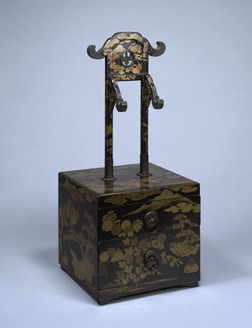
At the base of the mountains, there are depicted distant landscapes with undulating hills, and closer views of chrysanthemums, incense burners, and branches of pine trees adorned with robes. The meaning is derived from the Waka poem "Spring is excessive, summer is near, the pure white robe of the heavenly fragrance mountain," and is primarily expressed through Hiramaki-e and Enashi-ji art. It is an example of Koudai-ji Hiramaki-e popular during the Peach Mountain period.
基台部の各面には、遠景になだらかな起伏をもつ山々を配し、近景に菊や香炉、松の枝にかけられた衣を描いています。「春すぎて夏来にけらし白妙の 衣ほすてふ天の香具山」の和歌による意匠で、主に平(ひら)蒔絵と絵梨子地(えなしじ)によって表されています。桃山期に流行した高台寺(こうだいじ)蒔絵の一例です。
View the original at Japan Search →Article 1 sets a purpose larger than preservation: to preserve cultural properties AND to make use of them, contributing to the cultural advancement of the people and to the progress of world culture. Article 4 turns that outward. An owner must recognise the object as a precious national asset, preserve it for the public, and make it public as far as possible. Ownership here carries a duty to show.
The cool part. "Living National Treasure" appears nowhere in the statute. Article 71 requires that when an Important Intangible Cultural Property is designated, the minister must also certify its holder or holding group. Japan does not register the pot, it registers the potter. Article 96 is the one that reaches ordinary people: if you uncover a shell mound, a dwelling site or a tumulus, you must leave it exactly as it is and notify the Commissioner for Cultural Affairs without delay, and the Commissioner can freeze the ground for up to three months.
Verify at e-Gov 法令検索 →Use it Palette for a single-colour run: one ink, heavy stock, nothing else on the sheet.
Description source: museum curator text, translated — not generated