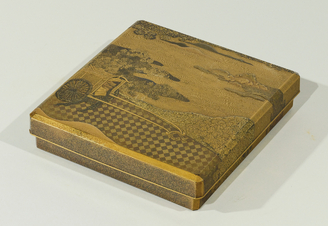
The lacquer box, with its open and closed sides, depicts palaces and carriages by the flowing water. Birds play at the water's edge, and chrysanthemums bloom in abundance and proudly. Chrysanthemums symbolize long life, and palaces were admired themes from the ancient court era. A high-quality painting serves as the base for the inlay work, and various lacquer techniques are employed, such as painting waves.
蓋の表裏から身の内にかけて、流水に御所車や殿舎を描く硯箱。水辺には水禽が遊び、菊の花々が今を盛りと咲き誇っています。菊は長寿の象徴であり、御所車は王朝時代への憧憬から好まれた題材でした。高(たか)蒔絵を基調に切金(きりかね)を丹念に置き、付描で波を描くなど、多様な蒔絵技術が駆使されています。
View the original at Japan Search →Article 1 sets a purpose larger than preservation: to preserve cultural properties AND to make use of them, contributing to the cultural advancement of the people and to the progress of world culture. Article 4 turns that outward. An owner must recognise the object as a precious national asset, preserve it for the public, and make it public as far as possible. Ownership here carries a duty to show.
The cool part. "Living National Treasure" appears nowhere in the statute. Article 71 requires that when an Important Intangible Cultural Property is designated, the minister must also certify its holder or holding group. Japan does not register the pot, it registers the potter. Article 96 is the one that reaches ordinary people: if you uncover a shell mound, a dwelling site or a tumulus, you must leave it exactly as it is and notify the Commissioner for Cultural Affairs without delay, and the Commissioner can freeze the ground for up to three months.
Verify at e-Gov 法令検索 →Use it A motif small enough to blind-deboss, which is where restraint actually shows.
Description source: museum curator text, translated — not generated