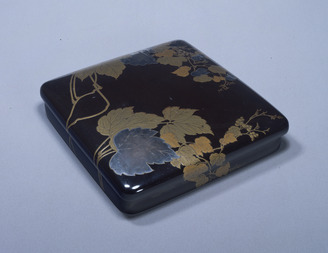
These paintings have a thin layer of gold leaf sandwiched between them, with bamboo on the surface and winter melon depicted from the back, suspended by hooks. These motifs can also be found in decorative paper scrolls from the Tang Dynasty, such as those related to Amida Nyorai. The fact that the surface and edges of the bamboo basket-shaped frames are rounded also suggests an influence from the Rinpa school.
金の薄肉高蒔絵を主体に銀金貝を交え、蓋表に蔦、蓋裏から懸子にかけては冬瓜を描いている。これらのモチーフは、本阿弥光悦の関与した嵯峨本などの料紙装飾にも見られる。蓋の肩や隅を丸くつくった袋形の形をとる点からも、琳派を意識した作品とみられる。
View the original at Japan Search →Article 1 sets a purpose larger than preservation: to preserve cultural properties AND to make use of them, contributing to the cultural advancement of the people and to the progress of world culture. Article 4 turns that outward. An owner must recognise the object as a precious national asset, preserve it for the public, and make it public as far as possible. Ownership here carries a duty to show.
The cool part. "Living National Treasure" appears nowhere in the statute. Article 71 requires that when an Important Intangible Cultural Property is designated, the minister must also certify its holder or holding group. Japan does not register the pot, it registers the potter. Article 96 is the one that reaches ordinary people: if you uncover a shell mound, a dwelling site or a tumulus, you must leave it exactly as it is and notify the Commissioner for Cultural Affairs without delay, and the Commissioner can freeze the ground for up to three months.
Verify at e-Gov 法令検索 →Use it The border is the idea. Use it as an edge treatment and leave the centre empty.
Description source: museum curator text, translated — not generated