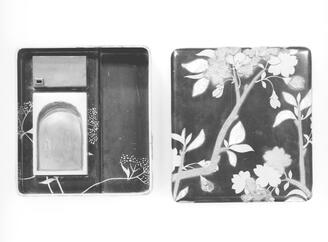
This catalog entry is about gold leaf and shell paintings, created using a board and brush. The artist uses gold leaf by cutting it and uses the board surface roughly. The bold expression of the Ōhara school (1658-1716) is evident. It looks as if it was not made at all, but the clever composition expands the sense of space.
金の平[ひら]蒔絵や螺鈿[らでん]、鉛板を用いて、桜の花枝を大きく配しています。貝を割って使ったり、鉛板の表面を荒らすなど、尾形光琳(1658~1716)風の大胆な表現です。無造作に切りとったかのようにみえますが、空間の広がりを感じさせる巧みな構図です。
View the original at Japan Search →Article 1 gives three grounds for regulating a sign: forming good landscape, maintaining scenic character, and preventing danger to the public. Article 3 then lets a prefecture prohibit outdoor advertising outright, by ordinance, in named categories of place.
The cool part. Read the list in Article 3 and it stops being an advertising law. The places where signage can be banned include landscape districts, scenic districts, preservation districts for groups of traditional buildings, the surroundings of designated Important Cultural Properties, and historic sites, places of scenic beauty and natural monuments. The statute protects the view by removing the sentences written across it.
Verify at e-Gov 法令検索 →Use it Palette for a single-colour run: one ink, heavy stock, nothing else on the sheet.
Description source: museum curator text, translated — not generated