Huang Goodman · Art Forgotten

Art Forgotten

Art from public museum collections. A mismatched real Japanese law, and some other factoids.

Every object, image and description comes from the museum's own catalogue record, and every object links to its original. Japanese records are machine-translated into English; the museum's Japanese is kept beside the translation because it is the authoritative form. Each law carries its official number and links to e-Gov 法令検索, the Japanese government's statute database.

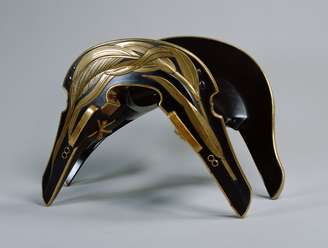
芦穂蒔絵鞍鐙(鞍)
{芦穂蒔絵鞍鐙(鞍) · 久松定法氏寄贈 · 安土桃山時代・16世紀 / Azuchi-Momoyama period, 16th century · Japan Search · 国立国会図書館}
Bamboo Hats and Scabbards (Saddles) This catalogue presents a collection of bamboo hats and saddles. These items were essential accessories for horseback riders in Japan. The hats protected the rider from the sun and rain, while the saddles ensured a comfortable and secure ride for both the horse and the rider. The bamboo hats, or kasa, were woven from split bamboo strips. The weaving technique created a watertight seal, making the hats effective rainwear. The hats were also lightweight and breathable, making them ideal for use in Japan's hot and humid climate. The bamboo saddles, or kabuto-mawari, were made by binding bamboo strips together in a lattice pattern. The saddles were then covered with rawhide or leather, providing a cushioned surface for the horse. The lattice design allowed for flexibility and enabled the saddle to conform to the shape of the horse's back. These bamboo hats and saddles are not only functional objects but also works of art. Their simple yet elegant design reflects the harmony between humans and nature that is a fundamental aspect of Japanese culture. This collection showcases a variety of bamboo hats and saddles, each with its unique characteristics. Some are adorned with decorative elements such as lacquer or metal fittings, while others maintain their natural beauty. All of these items are valuable reminders of Japan's rich history and cultural traditions. We hope that this catalogue will provide you with a deeper appreciation for these unique and beautiful objects. Enjoy your exploration of the world of bamboo hats and saddles. · Katsusongo Defu shi reikin (This was donated by Katsusongo Defu)

This is a saddle and a pair of stirrups from the use of Toyotomi Hideyoshi. The saddle's waist curves shallowly, and the width of the seat part is narrow, indicating the shape of a medieval saddle. It has gold lacquer paintings and gold shells that depict the shape of bamboo shoots, and a large copper gilt rosette that represents the dew on the leaves. This is an elegant and magnificent saddle and stirrup from the Azuchi-Momoyama period.

豊臣秀吉所用と伝わる鞍と鐙の一具。後輪の湾曲が浅く、居木(騎乗者が座る部分)幅が狭い中世後期鞍の形状を示しています。金高蒔絵と金貝で芦穂の姿をのびのびと描き、大きな銀鋲を加えて葉に宿る露を表しています。安土桃山時代を代表する、雄渾華麗な鞍鐙です。

View the original at Japan Search →
The law
図書館法
Library Act
昭和二十五年法律第百十八号 · Act No. 118 of 1950

Article 3 tells libraries what to gather, and the list is wider than books: local materials, local administrative records, works of art, records and film. Article 3 also requires interlibrary lending, travelling collections and mobile libraries, so that the holdings move toward the reader rather than waiting.

The cool part. Article 17 is one sentence and admits nothing. A public library may not collect an admission fee, or any consideration whatsoever, for the use of library materials. Free is not a policy that a budget round can revisit, it is the statute. Article 26 is stranger still: the state and local authorities must not interfere in the work of a private library, and must not give it a subsidy. Independence is protected by withholding the money.

Verify at e-Gov 法令検索 →

Use it A motif small enough to blind-deboss, which is where restraint actually shows.

Description source: museum curator text, translated — not generated