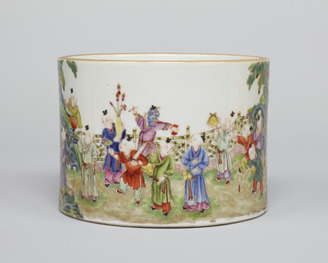
This is a large ink pen holder. The pen holder, which sits on a desk, was particularly valued for decorative stationery. The body of the pen holder features European wireless seven treasures technology applied as a powder coating, displaying a vivid and enjoyable scene of Chinese monkey play. Property of the late calligrapher Seien Shibata (1912-93).
大型の白磁胎の筆筒です。筆を挿す筆筒は、机上を飾る文房具としてとくに重視されました。胴部にはヨーロッパの無線七宝の技術をとりいれた粉彩によってあらわされた、賑やかで楽しげな唐子遊びの図が巡ります。書家青山杉雨(1912~93)旧蔵品。
View the original at Japan Search →Article 1 states the purpose plainly: prevent trade in stolen goods, find them quickly, and speed the recovery of victims. Article 2 then defines a used article to include, in the same breath, art objects held for appreciation. Dealing in them requires a licence.
The cool part. Article 16 requires a dealer to record every transaction: the date, the item and quantity, its distinguishing features, and the address, name, occupation and age of the other party. Article 15 requires that a dealer who suspects an item is stolen report it to a police officer immediately. So the antique trade runs on a register the police may read, and a painting becomes a second-hand article the moment it has been used once.
Verify at e-Gov 法令検索 →Use it The border is the idea. Use it as an edge treatment and leave the centre empty.
Description source: museum curator text, translated — not generated