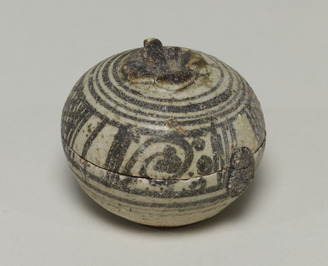
During the Ayutayo Kingdom in the 15th-16th centuries, an ironclad lower painting was made in the central kiln site of Seisachanara. The term "Songhu ru" originated from Sawankarok in the south of Seisachanara. In Japan, tea masters highly valued this lower painting as an important accessory.
アユタヤ王朝のもと、15~16世紀頃、中心的な窯地シーサッチャナーライで焼かれた下絵付けの鉄絵のうつわ。「宋胡録」とはシーサッチャナーライの南に位置するサワンカロークに由来します。日本では茶人たちがこれを柿に見立て、香合として珍重しました。
View the original at Japan Search →A statute built to coax privately held work onto public walls. An owner registers a piece with the Commissioner for Cultural Affairs, then contracts with a museum to display it. Article 2 defines a work of art broadly, as paintings, sculpture, crafts and other tangible cultural products that are movable, which is the legal way of saying anything you could carry out of the house.
The cool part. The terms are the interesting part. Article 2 requires the public display contract to run for five years or more, and to contain a clause stating that the parties may not give notice of cancellation. You cannot lend a masterpiece for the tax treatment and then reclaim it when the market turns. Japan concluded the barrier to seeing art was never storage. It was ownership, and the fix was a contract you cannot walk out of.
Verify at e-Gov 法令検索 →Use it Two-colour foil on uncoated stock gets you most of this at production cost.
Description source: museum curator text, translated — not generated