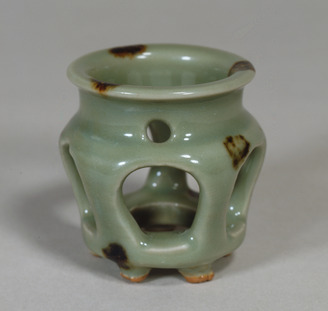
Fukasaki (Tobiseji) refers to a type of black-brown speckled pottery called hechi. It was popular in the ancient period in the Setouchi Province, Japan. The name "Yagaku" (night study) derives from its origin in China, where it was used as a stand for placing oil lamps for nighttime study sessions. The pottery was used in Japan to cover the lids of tea caskets.
飛青磁(とびせいじ)とは黒褐色の斑文を散らした青磁をいう。浙江(せっこう)省の龍泉窯(りゅうせんよう)で元時代に流行した。日本で茶釜の蓋を置く蓋置に見立てられている。夜学(やがく)の名は、中国で夜間の勉学に用いる灯明の火皿を置く台からの転用といわれることに由来する。
View the original at Japan Search →Unusually for a Japanese statute it opens with a preamble, which states that finding joy in creating culture and living among it is an unchanging wish of people, and that culture contributes to world peace. Article 2 then sets the principles: the autonomy of those who make culture must be fully respected, and their creativity, standing and capacity considered.
The cool part. Article 2, paragraph 3 is the line worth reading twice. It says that creating and receiving culture is a right people are born with, and requires an environment in which citizens can appreciate, participate and create regardless of age, disability, economic situation, or the area they live in. Four barriers named in statute, one of which is your postcode. It puts the arts in the same grammatical register as infrastructure. Not a subsidy argued for each year, a standing obligation.
Verify at e-Gov 法令検索 →Use it The border is the idea. Use it as an edge treatment and leave the centre empty.
Description source: museum curator text, translated — not generated