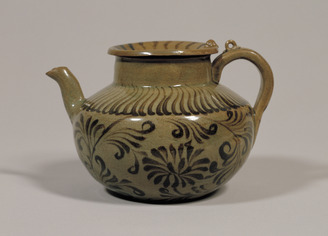
The brushwork is lively, and the entire piece is covered in tangsusu (Tang-dynasty calligraphy). The shoulder band with an S-shaped pattern is similar to examples from the Jishu kilns of China. The origin of the beautiful blue magnetic painting is said to be related to Chinese iron paintings. Due to the oxidation flame (san kae n), the overall piece has a yellow hue. The work is thought to be from the southern part of Korea, the southern route of the Unified Silla Kingdom.
躍動感のある筆遣いで、全面に唐草文が描かれています。肩部のS字状の文様帯は中国の磁州窯(じしゅうよう)に類例がありますが、高麗の青磁鉄絵の起源は中国南部の鉄絵との関係が指摘されています。酸化焔(さんかえん)のため、総体に黄色を帯びます。韓国全羅南道海南産とみられる作品です。
View the original at Japan Search →A craft cannot call itself traditional by taste or reputation. Article 2 sets five conditions, all of which must hold: it is used mainly in daily life, the main part of its making is by hand, it is made by traditional techniques, it is made chiefly from materials traditionally used, and a not-small number of people in a defined area still make it. The designation names the techniques, the materials and the region.
The cool part. Two conditions do quiet work. The first is daily use, so a technique kept alive only for display does not qualify. The fifth is the number of makers: the law will not protect a single surviving genius, because one person is a biography and not an industry. And because the region is written into the designation, the craft is legally attached to a place and cannot move.
Verify at e-Gov 法令検索 →Use it Take the ratio, not the picture. It sets a page better than a grid does.
Description source: museum curator text, translated — not generated