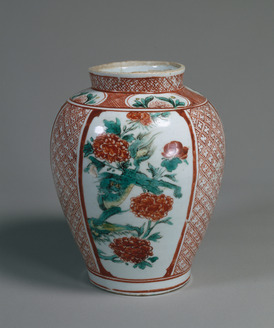
In the collection of Iwami, there are works that fit between the early color paintings and the period of transformation into the style of Karasumaru. On the three sides of the body, there are paintings of a lion, peonies, bamboo, and landscapes. One of the representative works of the museum's collection, "Courtesans of Kyoto," has a courtesan depicted beside it, which is indeed this very pot.
伊万里の色絵の中で、初期色絵から柿右衛門様式の転換期に位置付けられる作品。胴の三方には色絵によって獅子牡丹図、芭蕉図、山水図を描いている。当館蔵の速水御舟(はやみぎょしゅう)の代表作「京の舞妓」で舞妓の傍らに描かれているのが、まさしくこの壺である。
View the original at Japan Search →Article 1 sets a purpose larger than preservation: to preserve cultural properties AND to make use of them, contributing to the cultural advancement of the people and to the progress of world culture. Article 4 turns that outward. An owner must recognise the object as a precious national asset, preserve it for the public, and make it public as far as possible. Ownership here carries a duty to show.
The cool part. "Living National Treasure" appears nowhere in the statute. Article 71 requires that when an Important Intangible Cultural Property is designated, the minister must also certify its holder or holding group. Japan does not register the pot, it registers the potter. Article 96 is the one that reaches ordinary people: if you uncover a shell mound, a dwelling site or a tumulus, you must leave it exactly as it is and notify the Commissioner for Cultural Affairs without delay, and the Commissioner can freeze the ground for up to three months.
Verify at e-Gov 法令検索 →Use it Two-colour foil on uncoated stock gets you most of this at production cost.
Description source: museum curator text, translated — not generated