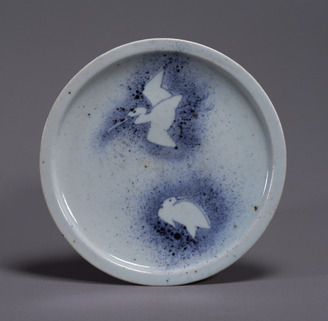
In the early Iwami period, bowls with a central design were most common as treasured items. The technique of applying the dye from the surface of the stencil and leaving the white background to show the design was learned at the Jochi-zen kiln. The spirit of Iwami is uniquely accompanied by this elegant feeling. This vessel representing a white heron is extremely rare, with very few examples existing.
初期伊万里には、中皿が遺品として最も多い。染付を型紙の上から吹き付け、型紙をとって白抜き文様を表わす手法は景徳鎮窯に学びながら、瀟條とした気分には伊万里ならではの風韻が伴う。この白鷺を表わす遺品は極めて数が少なく珍重されている。
View the original at Japan Search →Article 1 states the aim as a beautiful and dignified national land, and it covers not only cities but farming, mountain and fishing villages. Inside a landscape planning area, Article 16 requires advance notification of new building, extension, rebuilding, relocation, and any repair or alteration that changes the exterior. Landscape Districts go further and impose direct restrictions on the form and design of buildings.
The cool part. Read Article 16 to the end of the sentence. A change of colour is listed alongside new construction as an act you must notify. Repainting your building is, in law, the same category of event as putting up a new one. This is the machinery behind the muted shopfronts of Kyoto. The brown coffee-shop sign is not a marketing choice, it is compliance.
Verify at e-Gov 法令検索 →Use it The border is the idea. Use it as an edge treatment and leave the centre empty.
Description source: museum curator text, translated — not generated