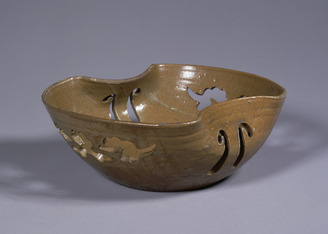
This catalog contains few records of Shigaruto Raku. The box label reads "Shigaruto Raku tea bowls from Shushu province." The popularity of transparent tea bowls is a characteristic of the early Edo period. These copper tea bowls have a strong sense of form, particularly in their handling of clouds and bamboo. The flat bottom has a Seta kiln mark, suggesting its origin.
数少ない志戸呂焼の資料であり、箱書には「駿州志と路焼菓子鉢」と書かれている。透鉢の流行は、江戸前期の特色であり、なかなか力強い造形に大きく蕨手と雲を切り抜いた力感こもった分銅形の鉢。平底の轆轤目は瀬戸系の窯であることを偲ばせる見所である。
View the original at Japan Search →A statute built to coax privately held work onto public walls. An owner registers a piece with the Commissioner for Cultural Affairs, then contracts with a museum to display it. Article 2 defines a work of art broadly, as paintings, sculpture, crafts and other tangible cultural products that are movable, which is the legal way of saying anything you could carry out of the house.
The cool part. The terms are the interesting part. Article 2 requires the public display contract to run for five years or more, and to contain a clause stating that the parties may not give notice of cancellation. You cannot lend a masterpiece for the tax treatment and then reclaim it when the market turns. Japan concluded the barrier to seeing art was never storage. It was ownership, and the fix was a contract you cannot walk out of.
Verify at e-Gov 法令検索 →Use it Two-colour foil on uncoated stock gets you most of this at production cost.
Description source: museum curator text, translated — not generated