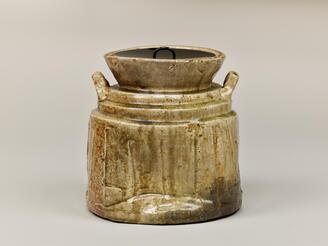
The belly is strongly indented, and three tiers of hera-shaped steps are carved at the sides of the ears. A green bead-like glaze is filled to the brim in the shoulder area, making it noticeable.
胴部を力強く凹ませ、縦方向にヘラ目も施された水指です。耳の辺りから三段にわたって階段状に削られた肩には緑色のビードロ釉がとっぷりと溜まり、見どころとなっています。
View the original at Japan Search →Article 2 defines a museum as an institution that collects, keeps and displays materials on history, art, folklore, industry and natural science for public use, carries out research on them, and which has been registered under Chapter 2 of this Act. The registration is not decorative. In law, an unregistered collection open to the public is not a museum.
The cool part. The definition of keeping is given as including raising. That single parenthesis is why a zoo, an aquarium and a botanical garden sit inside museum law in Japan: the collection is allowed to be alive. Article 1 also grounds the statute in the Social Education Act and the Basic Act on Culture and the Arts, which places museums in education first and culture second.
Verify at e-Gov 法令検索 →Use it Palette for a single-colour run: one ink, heavy stock, nothing else on the sheet.
Description source: museum curator text, translated — not generated