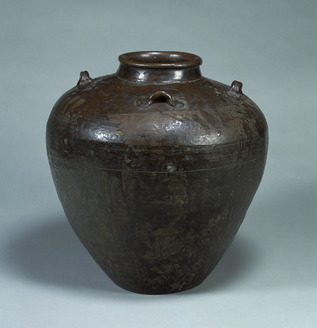
Sedehaku is a pottery from the Muromachi period that put more effort into making tea containers and tea bowls. This pottery piece has a mark of the production year on its bottom and is considered a standard work from the late Muromachi period. It uses a fine clay called "obasutama," which is shaped by being wrapped around a wheel. The glaze applied deliberately onto the rough surface awakens the sense of beauty in the mournful tea.
瀬戸窯は、室町時代に入ると茶壺や茶入の倣製に一層力を注いだ。この壺は器底に紀年銘があり、室町後期の基準作である。祖母懐土と言うきめの細かい土を使い、轆轤で成形している。わざとムラにかけた黒褐色の釉薬に侘茶の美意識の目覚めがうかがわれる。
View the original at Japan Search →A statute built to coax privately held work onto public walls. An owner registers a piece with the Commissioner for Cultural Affairs, then contracts with a museum to display it. Article 2 defines a work of art broadly, as paintings, sculpture, crafts and other tangible cultural products that are movable, which is the legal way of saying anything you could carry out of the house.
The cool part. The terms are the interesting part. Article 2 requires the public display contract to run for five years or more, and to contain a clause stating that the parties may not give notice of cancellation. You cannot lend a masterpiece for the tax treatment and then reclaim it when the market turns. Japan concluded the barrier to seeing art was never storage. It was ownership, and the fix was a contract you cannot walk out of.
Verify at e-Gov 法令検索 →Use it Two-colour foil on uncoated stock gets you most of this at production cost.
Description source: museum curator text, translated — not generated