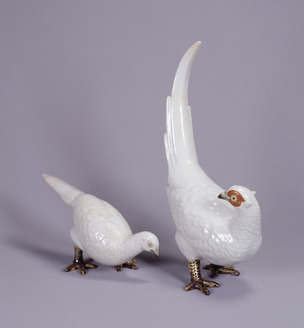
The Japanese pheasant, depicted in a realistic way, is native to Japan and is also the national bird of Japan. Five centuries ago, Sixbei Kiyomasa of the Kiyomasa clan was born in Kyoto and learned painting at the prestigious Shokoku-ji temple in Kyoto, under the guidance of his father, Fourteenth Sixbei. He learned techniques from Chinese ceramics and created decorative works in the Rin style, such as sculptures like this one. The Rin style is indeed rich and varied. (Ruby: Kobairei)
The Japanese pheasant, depicted here in a realistic manner, is native to Japan and is also the national bird of Japan. (平企_特集_親と子_170425) 五代清水六兵衛は、京都で代々陶業を営む清水家に生まれ、京都画壇の重鎮であった幸野楳嶺に絵を学び、父である四代六兵衛に陶芸の手ほどきを受けました。中国陶磁に学んだ技法から、琳派風の装飾性豊かなもの、本作のような彫塑作品など、その作風はじつに多彩です。ルビ:こうのばいれい
View the original at Japan Search →Unusually for a Japanese statute it opens with a preamble, which states that finding joy in creating culture and living among it is an unchanging wish of people, and that culture contributes to world peace. Article 2 then sets the principles: the autonomy of those who make culture must be fully respected, and their creativity, standing and capacity considered.
The cool part. Article 2, paragraph 3 is the line worth reading twice. It says that creating and receiving culture is a right people are born with, and requires an environment in which citizens can appreciate, participate and create regardless of age, disability, economic situation, or the area they live in. Four barriers named in statute, one of which is your postcode. It puts the arts in the same grammatical register as infrastructure. Not a subsidy argued for each year, a standing obligation.
Verify at e-Gov 法令検索 →Use it Two-colour foil on uncoated stock gets you most of this at production cost.
Description source: museum curator text, translated — not generated