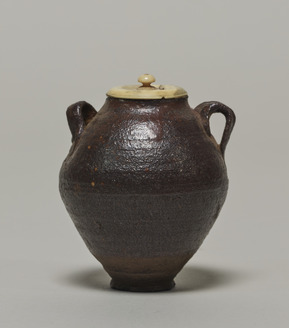
Regarding Tang dynasty tea wares, a certain group is referred to as "Isamuki." It is believed that their production originated in the southern part of China. Despite sharing the same materials such as clay and glaze, they exhibit distinct differences in shape, making them unique. This piece is intriguing due to the different ways its ears are attached. Donated by Horikawa Minbu.
唐物茶入に対し、耳が付いた一風変わった姿の一群は「島物」と呼ばれて区別される。おそらく生産地は中国南部と考えられるが、唐物茶入に同じく土や釉、姿にそれぞれ違いがあって個性豊かである。この作品は左右の耳の付け方が異なっていて面白い。横河民輔寄贈品。
View the original at Japan Search →Article 1 states the purpose plainly: prevent trade in stolen goods, find them quickly, and speed the recovery of victims. Article 2 then defines a used article to include, in the same breath, art objects held for appreciation. Dealing in them requires a licence.
The cool part. Article 16 requires a dealer to record every transaction: the date, the item and quantity, its distinguishing features, and the address, name, occupation and age of the other party. Article 15 requires that a dealer who suspects an item is stolen report it to a police officer immediately. So the antique trade runs on a register the police may read, and a painting becomes a second-hand article the moment it has been used once.
Verify at e-Gov 法令検索 →Use it The border is the idea. Use it as an edge treatment and leave the centre empty.
Description source: museum curator text, translated — not generated