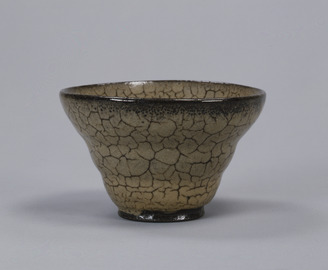
This technique involves layering two types of glaze, black and white klapenglaze, in a snakeskin pattern on this tea bowl. After applying the brown glaze, the white klapenglaze was added. The difference in the glaze's shrinkage rate caused the surface to develop the characteristic cracks resembling a turtle's shell. Discovered at an ancient kiln site of the Saga-yaki style in Kamamoto.
蛇蝎釉とは黒釉と白濁釉の二種類の釉薬を重ね掛けする技法をいい、この茶碗では褐釉を掛けたのちに白濁釉を掛け、釉薬の収縮率の差によって表面にうろこ状の亀裂が生じている。薩摩焼の元立院(げんりゅういん)系の窯跡において発見されている。
View the original at Japan Search →Article 2 defines a museum as an institution that collects, keeps and displays materials on history, art, folklore, industry and natural science for public use, carries out research on them, and which has been registered under Chapter 2 of this Act. The registration is not decorative. In law, an unregistered collection open to the public is not a museum.
The cool part. The definition of keeping is given as including raising. That single parenthesis is why a zoo, an aquarium and a botanical garden sit inside museum law in Japan: the collection is allowed to be alive. Article 1 also grounds the statute in the Social Education Act and the Basic Act on Culture and the Arts, which places museums in education first and culture second.
Verify at e-Gov 法令検索 →Use it A motif small enough to blind-deboss, which is where restraint actually shows.
Description source: museum curator text, translated — not generated