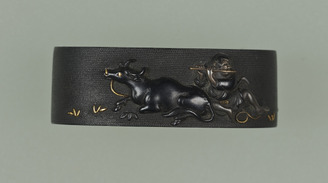
After starting with the name "Kougashi" (lit. Bright Coin), he changed it to "Kougyo" (lit. Bright Way). This transitional piece, from the early period of his work, features copper and gold alloy (ajisai), round filings shaped like fish, a small thatched hut with a cow and herder motif depicted in high relief on its meaty carvings. (Text by Mitsutaka Mitsuda, former head of the Sakei family)
後藤一乗ははじめ「光貨」と名乗り、次いで「光行」と改名した。この縁頭は一乗初期の作品で、赤銅(銅と少量の金の合金)の地金、丸文を連ねる魚々子地、茅葺きの小屋に牛と牧童の文様を半肉にする高肉彫など後藤家の刀装具に一般的な作風を示している。 るび みつたか みつゆき しゃくどう じがね ななこ たかにくぼり (酒井元樹氏執筆)
View the original at Japan Search →Article 1 states the aim as a beautiful and dignified national land, and it covers not only cities but farming, mountain and fishing villages. Inside a landscape planning area, Article 16 requires advance notification of new building, extension, rebuilding, relocation, and any repair or alteration that changes the exterior. Landscape Districts go further and impose direct restrictions on the form and design of buildings.
The cool part. Read Article 16 to the end of the sentence. A change of colour is listed alongside new construction as an act you must notify. Repainting your building is, in law, the same category of event as putting up a new one. This is the machinery behind the muted shopfronts of Kyoto. The brown coffee-shop sign is not a marketing choice, it is compliance.
Verify at e-Gov 法令検索 →Use it The border is the idea. Use it as an edge treatment and leave the centre empty.
Description source: museum curator text, translated — not generated