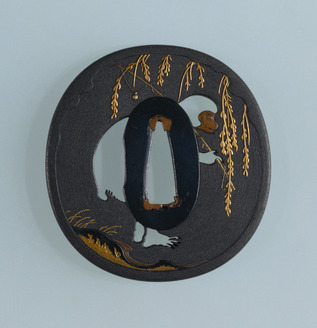
Eastern Dragon Clear Life was a swordsmith in the late Edo period of Japan. They created numerous works that were light and agile with intricate mechanisms. This piece reveals the posture of a monkey on one side, facing a pond with a cool, fishing expression, while on the other side it carries a fish cage and returns home under the moonlight. The unique characteristics of both sides of this mirror-like object are fully expressed in a humorous way through the monkey's form. (Text written by Rubi Toryusai)
東龍斎清寿は幕末の江戸で刀装具をつくり、軽妙で機転に富んだ作品が多い。これは猿の姿を切り透かして一面は涼しげに釣りに向かう姿、もう一面は月夜に魚籠を持って帰路に着く姿をあらわしており、表裏ある鐔の特性を存分に発揮したユーモラスな猿の姿がみられる。 るび とうりゅうさいきよとし びく (酒井元樹木氏執筆)
View the original at Japan Search →A statute built to coax privately held work onto public walls. An owner registers a piece with the Commissioner for Cultural Affairs, then contracts with a museum to display it. Article 2 defines a work of art broadly, as paintings, sculpture, crafts and other tangible cultural products that are movable, which is the legal way of saying anything you could carry out of the house.
The cool part. The terms are the interesting part. Article 2 requires the public display contract to run for five years or more, and to contain a clause stating that the parties may not give notice of cancellation. You cannot lend a masterpiece for the tax treatment and then reclaim it when the market turns. Japan concluded the barrier to seeing art was never storage. It was ownership, and the fix was a contract you cannot walk out of.
Verify at e-Gov 法令検索 →Use it A motif small enough to blind-deboss, which is where restraint actually shows.
Description source: museum curator text, translated — not generated