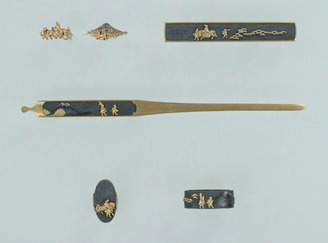
Among other sword accessories, the decorative heads of the nails that fix the collar (nakago) and hilt (tsuka) of a sword are called menuki. The comb-like tool used to fix the hair at the opening of the scabbard (saya) is called kougai. The small hilt (kogatana) of the knife attached to the back of the scabbard is called the kogatana-tsuka. The fuchigashira, which are ornaments at the ends of the hilt, are also considered part of the three essential accessories (mitokorimono) consisting of menuki, kougai, and kogatana.
鐔のほかの刀装具として、本来刀身の茎(なかご)と柄(つか)を固定する釘の頭の装飾であった目貫(めぬき)、鞘口の表に指し添える理髪の道具とされた笄(こうがい)、鞘口の裏に指し添える小刀(こがたな)の柄(つか)である小柄、柄の両端の金具である縁頭(ふちがしら)などがあり、揃いの目貫・笄・小柄を三所物(みところもの)と呼んでいる。
View the original at Japan Search →Article 1 states the aim as a beautiful and dignified national land, and it covers not only cities but farming, mountain and fishing villages. Inside a landscape planning area, Article 16 requires advance notification of new building, extension, rebuilding, relocation, and any repair or alteration that changes the exterior. Landscape Districts go further and impose direct restrictions on the form and design of buildings.
The cool part. Read Article 16 to the end of the sentence. A change of colour is listed alongside new construction as an act you must notify. Repainting your building is, in law, the same category of event as putting up a new one. This is the machinery behind the muted shopfronts of Kyoto. The brown coffee-shop sign is not a marketing choice, it is compliance.
Verify at e-Gov 法令検索 →Use it The border is the idea. Use it as an edge treatment and leave the centre empty.
Description source: museum curator text, translated — not generated