Huang Goodman · Art Forgotten

Art Forgotten

Art from public museum collections. A mismatched real Japanese law, and some other factoids.

Every object, image and description comes from the museum's own catalogue record, and every object links to its original. Japanese records are machine-translated into English; the museum's Japanese is kept beside the translation because it is the authoritative form. Each law carries its official number and links to e-Gov 法令検索, the Japanese government's statute database.

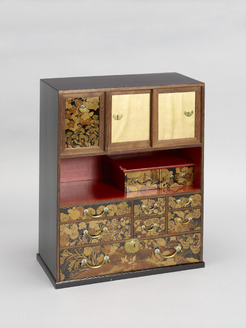
秋草蒔絵手下箪笥
{秋草蒔絵手下箪笥 · 京都国立博物館 Kyoto National Museum · 明治時代・20世紀 / Meiji ・20th · Japan Search · 国立国会図書館}
Autumn Leaves: Paintings under the Brush of Akasaka (Note: Akasaka is a name of a person, not a place or an artistic style.) · Kyoto National Museum (Kyoto Prefectural National Museum) is a museum located in Kamigyo Ward, Kyoto City. Established in 1895 as a prefectural museum, it was designated as a national museum in 1952. The museum houses various cultural properties, including ancient art and treasures from Kyoto and its surrounding areas. The collection covers a wide range of genres, including painting, calligraphy, sculpture, ceramics, metalwork, and textiles. The museum also holds special exhibitions and research activities, making it an important cultural institution in Kyoto. It is open from Tuesday to Sunday, with closed Mondays and New Year's holidays. The museum is accessible by public transportation, including bus and subway. There is an admission fee for some exhibitions, but some areas are free to enter. The museum has a library, a shop selling museum merchandise, and a restaurant on the premises.

In a wabe-room, living with comfort, this basket is convenient for making small things around oneself such as letters, stationery, calendars, and buttons. The main piece seems to be using an earthenware panel taken from an old lacquer box. The simple design of autumn leaves drawn on the black lacquer background has been loved since the medieval period. This style of arranging such designs is widely known as "Kyoto Temple Autumn Leaves.

和室に座して暮らすとき、身の回りの小物(手紙、文房具、手帳、ボタンなど何でも)をしまうのに便利な箪笥。本品は、古い漆器から採った蒔絵パネルを利用しているようだ。黒漆地にシンプルな蒔絵で華やかな秋草を描く様式は、近世を通じて愛された。この様式の調度を多く伝える秀吉の菩提寺にちなみ「高台寺蒔絵」と呼ばれる。

View the original at Japan Search →
The law
古物営業法
Antique Dealings Act
昭和二十四年法律第百八号 · Act No. 108 of 1949

Article 1 states the purpose plainly: prevent trade in stolen goods, find them quickly, and speed the recovery of victims. Article 2 then defines a used article to include, in the same breath, art objects held for appreciation. Dealing in them requires a licence.

The cool part. Article 16 requires a dealer to record every transaction: the date, the item and quantity, its distinguishing features, and the address, name, occupation and age of the other party. Article 15 requires that a dealer who suspects an item is stolen report it to a police officer immediately. So the antique trade runs on a register the police may read, and a painting becomes a second-hand article the moment it has been used once.

Verify at e-Gov 法令検索 →

Use it Two-colour foil on uncoated stock gets you most of this at production cost.

Description source: museum curator text, translated — not generated