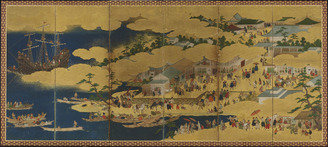
Discovered screen painting of new finding. On the right side, a captain Moro and his crew, who arrived in Japan on a black southern barbarian ship, are depicted in a conventional way as seen in many southern barbarian screens. However, on the left side, a white Chinese trading ship is shown docking, which is quite unusual for this type of painting. The painting skillfully renders the details of the motif while maintaining harmony in the overall depiction. It is believed to have been painted by a painter of the Kanō school, possibly Kanō Eitoku (1571-1618), during the Tensho era (1596-1614).
新発見の南蛮屏風の優品。日本に到着した黒い南蛮船と、南蛮寺に向かうカピタン・モールの一行を描く右隻は、いわゆる南蛮屏風の定型的な表現をとっているが、左隻に白い唐船が入港する中国の港町を描くことはとても珍しく、本図の特徴の一つとなる。 その画面は、モチーフを細部まで丁寧に描き込みながら、かつ全体を調和させる描写力が見所。描いたのは狩野派正系の画家、おそらくは狩野孝信(1571〜1618)の手により慶長年間(1596〜1614)に制作されたと考えられる。
View the original at Japan Search →Unusually for a Japanese statute it opens with a preamble, which states that finding joy in creating culture and living among it is an unchanging wish of people, and that culture contributes to world peace. Article 2 then sets the principles: the autonomy of those who make culture must be fully respected, and their creativity, standing and capacity considered.
The cool part. Article 2, paragraph 3 is the line worth reading twice. It says that creating and receiving culture is a right people are born with, and requires an environment in which citizens can appreciate, participate and create regardless of age, disability, economic situation, or the area they live in. Four barriers named in statute, one of which is your postcode. It puts the arts in the same grammatical register as infrastructure. Not a subsidy argued for each year, a standing obligation.
Verify at e-Gov 法令検索 →Use it Two-colour foil on uncoated stock gets you most of this at production cost.
Description source: museum curator text, translated — not generated