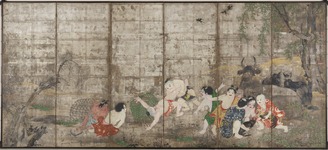
A screen painting by the enigmatic artist Kitagawa Utamaro (approximately 1730-1781) was recently discovered in this gallery, which had been hidden away for some time. This work, a copy by a later artist, features a landscape setting with willow trees, cows, and rivers on either side. The scene outside the door depicts children at play and two women. The unique characteristic of this painting is the depiction of peculiar figures with silver hair on their backs. The clothing of the figures is rendered with vibrant colors, water ink, and gold powder, conveying the diverse expression of Utamaro's art.
近年まで秘蔵されていた幻の曾我蕭白(1730〜1781)の屏風絵。後世の画家による模写(コピー)で知られていた作品が出現し、当館の所蔵となった。 柳樹や牛、川などの背景を左右に配し、戸外に遊ぶ子供たちと二人の女性を描いた作品の特徴は、珍しく銀地をバックにする奇矯な人物の描写である。人物の服装が彩色や水墨、金泥を自由にもちいて描かれており、曾我蕭白の多彩な表現を伝える絵画として重要である。
View the original at Japan Search →Unusually for a Japanese statute it opens with a preamble, which states that finding joy in creating culture and living among it is an unchanging wish of people, and that culture contributes to world peace. Article 2 then sets the principles: the autonomy of those who make culture must be fully respected, and their creativity, standing and capacity considered.
The cool part. Article 2, paragraph 3 is the line worth reading twice. It says that creating and receiving culture is a right people are born with, and requires an environment in which citizens can appreciate, participate and create regardless of age, disability, economic situation, or the area they live in. Four barriers named in statute, one of which is your postcode. It puts the arts in the same grammatical register as infrastructure. Not a subsidy argued for each year, a standing obligation.
Verify at e-Gov 法令検索 →Use it Two-colour foil on uncoated stock gets you most of this at production cost.
Description source: museum curator text, translated — not generated