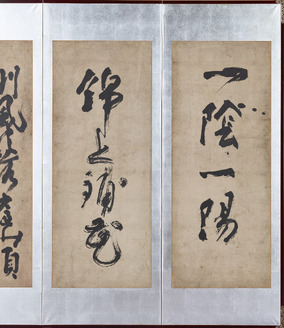
The brushstrokes are strong and restrained, creating contrast and depth on the paper. On the right, Chinese characters and poetry are inscribed, while on the left, the titles and authors of "Thirty-Six Poets" are indicated. The seals stamped on each of the sixth panels, specifically "Spring Depth," "Morning at the Eastern Mountain," and "Spring Depth at Mount Hiei," reveal that the artist is a member of the Toynobe family and a monk named Spring Deep from Koyasan.
力強く抑揚のある筆致と墨の潤渇が、紙面にコントラストと奥行きを与えています。右隻に漢語・漢詩を、左隻に『三十六人大歌合』より和歌と作者を揮毫しています。各第六扇に捺された「春深」「道朝」「阿闍梨道朝」の朱印から、表野家出身で高野山の僧・春深の書とわかります。
View the original at Japan Search →Japan implementing the 1970 UNESCO Convention. When a foreign state reports that cultural property has been stolen from an institution, the Ministry of Foreign Affairs notifies the education ministry, which designates the object as specified foreign cultural property, after consulting the trade ministry. Importing a designated object then requires approval under the foreign exchange and trade law.
The cool part. Article 6 quietly rewrites private law. Under the Civil Code a good-faith purchaser is normally secure against a recovery claim after two years. For designated stolen foreign cultural property, the victim may demand recovery from two years after the theft until ten years have passed. Buying in good faith does not settle the question for a decade, which is roughly how long it takes a stolen object to surface on a legitimate market.
Verify at e-Gov 法令検索 →Use it Palette for a single-colour run: one ink, heavy stock, nothing else on the sheet.
Description source: museum curator text, translated — not generated