Quiet reading✦No ads, ever

✦Corporate brand & media services✦Made in Virginia Beach since 1997✦

Huang Goodman · Art Forgotten

Art Forgotten

Art from public museum collections. A mismatched real Japanese law, and some other factoids.

Every object, image and description comes from the museum's own catalogue record, and every object links to its original. Japanese records are machine-translated into English; the museum's Japanese is kept beside the translation because it is the authoritative form. Each law carries its official number and links to e-Gov 法令検索, the Japanese government's statute database.

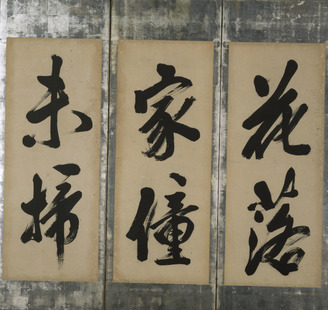
唐詩屏風
{唐詩屏風 · 三井親和筆 · 江戸時代・18世紀 / Edo period, 18th century · Japan Search · 国立国会図書館}
Tang Poem Screen This screen, a work of art from the Tang dynasty, is composed of multiple panels. Each panel features a calligrapher's elegant handwriting of a Chinese poem, accompanied by an illustration. The poems selected for this screen were popular during the Tang dynasty and continue to be appreciated in Chinese culture for their beauty and depth. The screen panels are made of wood and are covered with layers of lacquer. The lacquer coating provides a smooth, glossy finish, enhancing the visual appeal of the calligraphy and illustrations. The intricate designs on the illustrations are meticulously carved into the lacquer, creating a raised, three-dimensional effect. The poems and illustrations on the screen depict various themes, including nature, love, and the passage of time. The calligraphy is executed with great skill, showcasing the individual character's unique style and artistic flair. The illustrations are equally impressive, demonstrating the artist's mastery of line, form, and composition. This Tang Poem Screen is not only a valuable historical artifact but also a testament to the beauty and richness of Chinese culture. Its intricate designs and poetic verses continue to captivate and inspire viewers, making it an essential addition to any collection of Chinese art. · Three Co. Brush This brush was produced by Mitsui Home Co., Ltd. It is made of natural materials, primarily bamboo and animal hair. The brush's handle is made from a single piece of bamboo, which has been carefully selected for its strength and durability. The bristles are made from high-quality animal hair, known for its ability to retain water and create fine lines. The brush is traditionally crafted using techniques passed down through generations. Its simple yet elegant design reflects the traditional Japanese aesthetic. This brush has been used for various forms of calligraphy and painting in Japan for centuries. It is a valuable tool for artists seeking to create intricate and expressive works of art. The brush's handle is gently tapered, allowing for a comfortable grip and precise control. The bristles are arranged in a way that ensures even ink distribution and consistent line width. This brush requires regular maintenance to keep it in optimal condition. Proper care includes cleaning after each use and storing in a dry place. Through its use, this brush becomes an extension of the artist's hand, allowing them to bring their vision to life on paper.

Matsunaga Heigo of the Edo period was a calligrapher and martial artist. He studied under the calligrapher Hosokawa Taku in the Fine River District. The value of his calligraphy is high, bearing the name "Matsunaga." One of his works is a large calligraphy of a poem from the Seven Poems of the Pine Wilt, attributed to the Tang dynasty poet Wang Wei. This impressive calligraphy is considered a masterpiece among Matsunaga's surviving works. (130226_h082)

三井親和は、江戸時代中期の書家・武術家。書は細井広沢(ほそいこうたく)に学び、深川の親和の名で、その書名は高い。唐の詩人王維(おうい)の田園楽七首のうちの一首を、大書したものである。その雄揮な書は、親和の現存遺墨の中でも最高傑作と考えられる。(130226_h082)

View the original at Japan Search →
The law
古都における歴史的風土の保存に関する特別措置法
Act on Preservation of Historical Landscape in Ancient Capitals
昭和四十一年法律第一号 · Act No. 1 of 1966

It protects not the buildings but the setting that holds them. Article 2 defines historic landscape as land where structures and remains of historical significance form a single whole with the surrounding natural environment, which is the legal way of saying the hills, the approaches and the sightlines. The ancient capitals are Kyoto, Nara and Kamakura, plus any other municipality added by Cabinet Order. The Minister of Land, Infrastructure, Transport and Tourism designates a preservation area; city planning then carves a Special Preservation District over its core, and inside that district an owner needs permission from the prefectural governor to build, to fell timber, or to change the shape of the ground.

The cool part. It legislates the view, and then it pays for it. Article 10 requires the prefecture to compensate an owner who suffers loss because permission was refused. Article 12 goes further: where refusal seriously impairs the use of the land, the owner can require the prefecture to buy it, at market value. So the state does not merely tell you what the horizon behind a temple may look like. It agrees to purchase the land rather than let the skyline change. Two more things worth knowing. The prefecture must physically sign the district boundary, and a landowner may not obstruct the sign without just cause. And the ministry holding the pen is Transport, not Culture.

Verify at e-Gov 法令検索 →

Use it Palette for a single-colour run: one ink, heavy stock, nothing else on the sheet.

Description source: museum curator text, translated — not generated