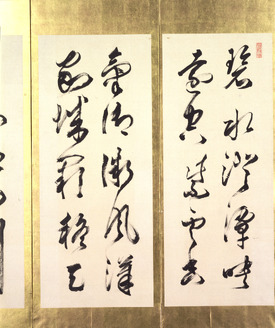
The man named Sansuke was a Confucian scholar, calligrapher, and painter during the late Edo period. This byobu (folding screen) features the calligraphy of seven-syllable poems in two sets of six and one. The year recorded at the end, "Dingri zhi Winter," indicates that Sansuke was around 80 years old when he wrote this. Besides Chinese calligraphy, Sansuke studied the art of ink painting in our country, such as that of Suikei. This legacy of Sansuke's calligraphic prowess is evident in this piece.
貫名菘翁は、江戸時代末期の儒者・書家・画家。この屏風は七言律詩2首を六曲一双に大きく書いたもので、末尾の「丁巳之冬月」の年紀から、菘翁80歳の筆と知られる。中国書法だけでなく、わが国の空海など名筆を学んだ、菘翁の能書ぶりを発揮した遺墨である。
View the original at Japan Search →A craft cannot call itself traditional by taste or reputation. Article 2 sets five conditions, all of which must hold: it is used mainly in daily life, the main part of its making is by hand, it is made by traditional techniques, it is made chiefly from materials traditionally used, and a not-small number of people in a defined area still make it. The designation names the techniques, the materials and the region.
The cool part. Two conditions do quiet work. The first is daily use, so a technique kept alive only for display does not qualify. The fifth is the number of makers: the law will not protect a single surviving genius, because one person is a biography and not an industry. And because the region is written into the designation, the craft is legally attached to a place and cannot move.
Verify at e-Gov 法令検索 →Use it A motif small enough to blind-deboss, which is where restraint actually shows.
Description source: museum curator text, translated — not generated