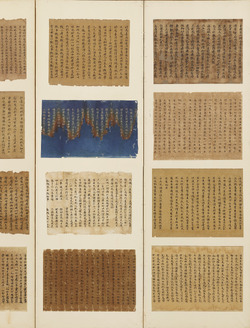
This screen painting, titled "Hyakman Todarani," consists of 31 fragments of sutras from the Nara and Kamakura periods. Most of these fragments are inscribed on blue paper with silver characters. The balanced arrangement of these fragments, taking into consideration the color of the paper and the size of the characters, was achieved carefully. In the past, people would cut out parts of books or scrolls and place them in albums, which we now call albums. By placing these albums close at hand, one could enjoy reading the books intimately and use them as models for learning. The screen painting introduced here is based on this concept. This screen painting has carefully arranged 31 fragments of sutras, considering the color of the paper and the size of the characters for balanced placement. The sutras on the screen painting were originally scrolls, which are made by pasting sheets of paper horizontally in a fixed size. Most of the sutras on the screen painting are pasted in their original sizes. In an album, one has to cut the fragments to fit the size, but in this screen painting, larger sizes can be pasted. Additionally, by pasting multiple sutras together, it became possible to compare them and view the whole composition at a glance. Furthermore, the advantage of being able to appreciate it with a large audience also seemed to be a factor.
百万塔陀羅尼(ひゃくまんとうだらに)、紺紙銀字華厳経(二月堂焼経)、細字経、紺紙金銀字交書経、大般涅槃経(だいはつねはんぎょう)など、奈良から鎌倉時代の古経31枚を貼交ぜた屏風。ほとんどが断簡であるが、料紙(りょうし)の色合い、文字の大きさなどを考慮しながら、バランスのとれた配置がされている。(20060425_h031 or 2008122_h031) 昔の人の書や経巻の一部を切り取って冊子にとじる、今で言うアルバムのようなものを手鑑(てかがみ)といいます。手鑑を身近に置くことで個人的に書を楽しんだり、手習いの見本としました。その手鑑を応用したものが、今回ご紹介する貼交(はりまぜ)屏風です。 この屏風は31枚の写経の断片を、紙の色合いや文字の大きさなどを考慮しながら、バランスよく配置しています。屏風に貼り交ぜられている写経は奈良時代から鎌倉時代のもので、もともとは巻物の形をしていました。巻物は一定のサイズの紙を横に貼り継いで仕立てますが、ここに貼られている写経の大半はその紙の本来の大きさで貼られたものです。手鑑では冊子にとじられるサイズに断片を切り取る必要がありましたが、屏風ではもっと大きなサイズを貼り付けることができました。さらに屏風に貼り交ぜたことで、複数の経典を見比べることや一目で全体を見渡すことが可能になりました。また、大勢で鑑賞できるという利点もあったようです。 江戸時代以降、庶民の間でも書画を楽しむ文化が広まりましたが、経巻は高価であったため、誰でも入手できるものではなかったようです。断片であれば比較的手に入りやすく、それを手鑑や貼交屏風にして楽しんだのでしょう。 時代や様式のバリエーションを見比べながら、この作品を楽しんでみてはいかがでしょうか。
View the original at Japan Search →A craft cannot call itself traditional by taste or reputation. Article 2 sets five conditions, all of which must hold: it is used mainly in daily life, the main part of its making is by hand, it is made by traditional techniques, it is made chiefly from materials traditionally used, and a not-small number of people in a defined area still make it. The designation names the techniques, the materials and the region.
The cool part. Two conditions do quiet work. The first is daily use, so a technique kept alive only for display does not qualify. The fifth is the number of makers: the law will not protect a single surviving genius, because one person is a biography and not an industry. And because the region is written into the designation, the craft is legally attached to a place and cannot move.
Verify at e-Gov 法令検索 →Use it Two-colour foil on uncoated stock gets you most of this at production cost.
Description source: museum curator text, translated — not generated