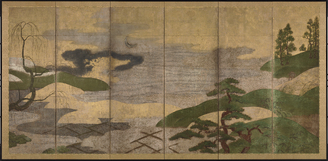
A large screen consists of six panels. Two sets of these panels face each other. On the right, there is a scene of cherry blossoms in spring with large, waving branches and vigorously flowing water. In contrast, on the left, there is a tranquil image of a river's stylized flow, a countryside landscape with a snow-covered hill in the background. Upon closer inspection, the impressions on the right and left are quite different. The right panel portrays the clouds as if they have broken through golden or silver armor, and variously sized leaves are attached. In contrast, the left panel is dominated by pressed paper technique, creating a very serene impression. Additionally, on the right panel, white powder (gosho) is used to add texture to the cherry blossoms and the edges of bridges. However, this is barely present on the left. The way the compositions and techniques differ, as well as the fact that the two panels appear to have been originally separate screens, suggest that they were combined to create this artwork. It is interesting to note the representation of the sun and moon. The sun is depicted on the right, and the moon on the left, both with golden and silver metal plates attached. This was a popular technique during this period. When one thinks of screens from the Muromachi era, images of Zen temple water ink paintings often come to mind.
6枚のパネルで構成された大きな屏風が、左右で1セットになっています。 向かって右は桜が咲きほこる春の景色、左は刈田の広がる秋から冬の景色です。しかし、よく見ると左右の印象がだいぶ違います。右の屏風は、桜や柳の木が大きくうねり、勢いよく流れ落ちる水流を描いて、動的なイメージなのに対して、左の屏風は様式化された水の流れを中心に、穏やかな田園風景と雪化粧した丘を遠景で捉えた、たいへん静かなイメージです。 右の屏風では、雲が金銀の箔(はく)を破ったり、大小さまざまな大きさにきったりしたものを貼り付けて表わされていますが、左の屏風では、大部分が箔押しによるものでたいへんおとなしい印象です。さらに、右では、桜の花弁や橋の欄干に胡粉(ごふん)という白い絵の具を盛り上げた立体的な表現が使われていますが、左にはほとんどありません。こうした、画面の構成や、技法の違い、またふたつの画面がつながらないことから、もとは別々の屏風だったのが、組み合わされたものと思われます。 面白いのは、太陽と月の表現です。右には太陽、左には月が表わされていますが、それぞれ金と銀でメッキされた金属板が貼り付けられているのです。これは、この時代に流行した技法です。 室町時代の屏風というと禅宗寺院の水墨画をイメージする方が多いと思いますが、なかにはこうした装飾的で華やかな作品もあるのです。それほど多くの作品が残されているわけではないので、こうしてご覧いただくのはとても貴重な機会といえるでしょう。 大きく屈曲する桜や柳、うねりながら流れ落ちる水流を描く動的な右隻。穏やかな水面や田園を捉える静的な左隻。画面全体で四季の景色を描きますが、もとは別の屏風が組み合わされたものです。鍍金、鍍銀された金属板の太陽と月の光が印象的です。
View the original at Japan Search →Article 1 sets a purpose larger than preservation: to preserve cultural properties AND to make use of them, contributing to the cultural advancement of the people and to the progress of world culture. Article 4 turns that outward. An owner must recognise the object as a precious national asset, preserve it for the public, and make it public as far as possible. Ownership here carries a duty to show.
The cool part. "Living National Treasure" appears nowhere in the statute. Article 71 requires that when an Important Intangible Cultural Property is designated, the minister must also certify its holder or holding group. Japan does not register the pot, it registers the potter. Article 96 is the one that reaches ordinary people: if you uncover a shell mound, a dwelling site or a tumulus, you must leave it exactly as it is and notify the Commissioner for Cultural Affairs without delay, and the Commissioner can freeze the ground for up to three months.
Verify at e-Gov 法令検索 →Use it The border is the idea. Use it as an edge treatment and leave the centre empty.
Description source: museum curator text, translated — not generated