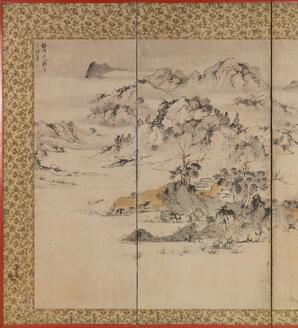
In this scene, full of water, there are softly colored trees and people. The distinctive feature is the dotted lines reminiscent of jumping ink. From the title at the upper left, "Meijiro Fisherman by Renga Brush in Rakuhoku," we learn that it was created at the large Sakata (Great Sakata) place. Meijiro was a scholar in Great Sakata, known for his deep creativity in waka poetry. He served as a retainer for the lord of Ise Island, Snow Seckei.
満々と水をたたえた景に、ほのかに色づく樹木や人物。跳ねるような濃墨の筆さばきが特徴的です。左上「梅厓漁人漫筆于浪華」から大坂での制作と分かります。梅厓は大坂の儒学者で和歌にも造詣が深く、多芸多才を発揮。伊勢長島藩主の増山雪斎の家臣となりました。
View the original at Japan Search →Article 2 defines a museum as an institution that collects, keeps and displays materials on history, art, folklore, industry and natural science for public use, carries out research on them, and which has been registered under Chapter 2 of this Act. The registration is not decorative. In law, an unregistered collection open to the public is not a museum.
The cool part. The definition of keeping is given as including raising. That single parenthesis is why a zoo, an aquarium and a botanical garden sit inside museum law in Japan: the collection is allowed to be alive. Article 1 also grounds the statute in the Social Education Act and the Basic Act on Culture and the Arts, which places museums in education first and culture second.
Verify at e-Gov 法令検索 →Use it Two-colour foil on uncoated stock gets you most of this at production cost.
Description source: museum curator text, translated — not generated