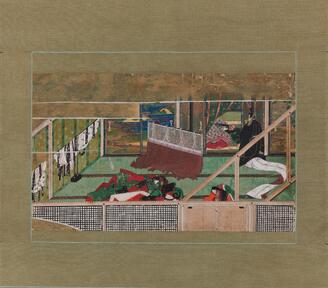
This illustration was donated to the royal family and was kept in this museum during that time. It is believed to be a copied version of a Spring of Life painting by Hokusai. The pre-war Tokyo National Museum actively produced and displayed such copies.
本図は春日権現験記絵が皇室に献納され、当館に保管されていた間に模写されたもので、原本から直接写された可能性がある。戦前の東京国立博物館では積極的に絵画の模写を行ない、展示に活用していた。
View the original at Japan Search →A statute built to coax privately held work onto public walls. An owner registers a piece with the Commissioner for Cultural Affairs, then contracts with a museum to display it. Article 2 defines a work of art broadly, as paintings, sculpture, crafts and other tangible cultural products that are movable, which is the legal way of saying anything you could carry out of the house.
The cool part. The terms are the interesting part. Article 2 requires the public display contract to run for five years or more, and to contain a clause stating that the parties may not give notice of cancellation. You cannot lend a masterpiece for the tax treatment and then reclaim it when the market turns. Japan concluded the barrier to seeing art was never storage. It was ownership, and the fix was a contract you cannot walk out of.
Verify at e-Gov 法令検索 →Use it The border is the idea. Use it as an edge treatment and leave the centre empty.
Description source: museum curator text, translated — not generated