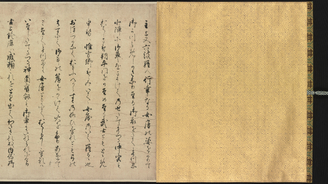
The scroll of battle paintings was born in the aristocratic society centered around the late Heian period's Emperor Go-Shirakawa. It is a precious example of this genre, depicting the military story "Heiji Monogatari," which uses the Heiji Disturbance (1159) as its theme. This scroll shows the scene of Emperor Sutoku, who was confined by his mother, the Empress Dowager Fujiwara Michinori and Fujiwara Nobuyori, escaping from the confines of the Fujiwara residence and being welcomed at the mansion of Taira no Kiyomori. During the late Heian period's first year of the Heiji era (1159), the power struggle between the two influential families, the Fujiwara (Fujiwara Michinori and Fujiwara Nobuyori), led to the military conflicts between Taira no Kiyomori and Minamoto no Yoritomo. This scroll depicts the Heiji Disturbance. Currently, one volume of this "Heiji Monogatari Scroll" is housed in the Boston Museum of Fine Arts, Tokyo Seikado Bunko Museum, and Tokyo National Museum. Four volumes of the remaining fragments also exist. This scroll depicts in detail the scene of Emperor Sutoku, who escapes from the confines of the Fujiwara residence, dressed as a woman, and is welcomed at the Taira mansion. First, take a look at the entire scene. The representation of the crowd of people in terms of size and arrangement, as well as the dynamic composition, is impressive.
合戦絵巻は後白河法皇を中心とする貴族社会で誕生した。これは合戦絵巻を代表する優品で、平治の乱(1159)を題材とする軍記物語『平治物語』を描いた大部な絵巻の一部。この巻は、平清盛らが二条天皇を六波羅の清盛邸に迎える内容を描く。 平安時代末期の平治元年(1159年)、権力をめぐる2人の公家、藤原通憲(ふじわらのみちのり)と藤原信頼(のぶより)の争いが、武家の平清盛(たいらのきよもり)と源義朝(みなもとのよしとも)の武力抗争に発展した平治の乱を描いた合戦絵巻です。 「平治物語絵巻」は現在、アメリカのボストン美術館、東京の静嘉堂文庫(せいかどうぶんこ)美術館、そして東京国立博物館がそれぞれ1巻ずつ所蔵しており、ほかに断簡十数枚が残されています。 当館が所蔵するこの六波羅行幸巻は、源氏方に幽閉された二条天皇(にじょうてんのう)が女房の衣装を身に付けて御所をひそかに脱出し、平清盛の六波羅邸へ迎えられる場面を描いています。 まず全体を見渡してみてください。人物の集団の大小、その配置の仕方、動きのある構図による群像表現が見事です。次に、細部を見てみましょう。武士たちのきゅっと引き締まった脚など躍動する肉体の表現。叫んだり、笑ったり、くやしがったり、豊かに描き分けられた人物の表情。きびきびした描線と美しい色彩によって動乱の緊迫したシーンをみごとに描ききっています。この絵巻は当時最高の絵師集団によって描かれたものでしょう。 ところで、このすばらしい絵巻を作らせたのはどんな人だったのでしょうか。貴族たちが白く端正な顔立ちで描かれているのに対して、武士はどんぐり眼(まなこ)に鷲鼻(わしばな)の下卑た様子で描かれています。さらに、よく統率された武士たちがかしこまっている様子は、この絵巻を描かせたのが公家の側であったことを物語っています。公家から武家へ、政治の大転換期を記録する歴史絵巻を描かせたのは、政治の舞台から去る公家の側でした。せめて絵巻の中では、武士たちをこんなふうにコントロールしていたかったのかもしれません。 平安時代末期の平治元年(1159)、政治の実権をめぐる藤原通憲(ふじわらのみちのり)(信西(しんぜい))と藤原信頼(ふじわらののぶより)の争いが、平清盛(たいらのきよもり)と源義朝(みなもとのよしとも)の武力抗争に発展した平治の乱を描いた合戦絵巻です。 「平治物語絵巻」は現在、三条殿夜討巻(さんじょうどのようちのまき)(ボストン美術館蔵)、信西巻(静嘉堂文庫美術館蔵)、そしてこの六波羅行幸巻の三巻と、断簡十数葉が残されています。六波羅行幸巻は、源氏方に幽閉された二条天皇(にじょうてんのう)が女房の姿で内裏をひそかに脱出し、清盛の六波羅邸へ迎え取られる場面を全四段に描きます。 ひし形をはじめとする様々な群像で武士団をとらえる構図。均直な屋台線。表情豊かな登場人物たち。どこを見てもため息が出るようなその技量は、当時最高の絵師集団によってこの絵巻が作られたことを物語っています。 詞書(ことばがき)を見てみると、随所に波打ったような文字が散見されます。この特徴的な「震え筆」は弘誓院教家(ぐぜいいんのりいえ)(1194~1255)晩年の筆跡と考えられ、この絵巻の制作も13世紀半ば頃と想定されています。
View the original at Japan Search →It protects not the buildings but the setting that holds them. Article 2 defines historic landscape as land where structures and remains of historical significance form a single whole with the surrounding natural environment, which is the legal way of saying the hills, the approaches and the sightlines. The ancient capitals are Kyoto, Nara and Kamakura, plus any other municipality added by Cabinet Order. The Minister of Land, Infrastructure, Transport and Tourism designates a preservation area; city planning then carves a Special Preservation District over its core, and inside that district an owner needs permission from the prefectural governor to build, to fell timber, or to change the shape of the ground.
The cool part. It legislates the view, and then it pays for it. Article 10 requires the prefecture to compensate an owner who suffers loss because permission was refused. Article 12 goes further: where refusal seriously impairs the use of the land, the owner can require the prefecture to buy it, at market value. So the state does not merely tell you what the horizon behind a temple may look like. It agrees to purchase the land rather than let the skyline change. Two more things worth knowing. The prefecture must physically sign the district boundary, and a landowner may not obstruct the sign without just cause. And the ministry holding the pen is Transport, not Culture.
Verify at e-Gov 法令検索 →Use it Take the ratio, not the picture. It sets a page better than a grid does.
Description source: museum curator text, translated — not generated